
AI-Driven Business Transformation
Align AI with leadership decision-making. Deploy AI across sales, operations, and management. Replace fragmented experiments with one operating system.
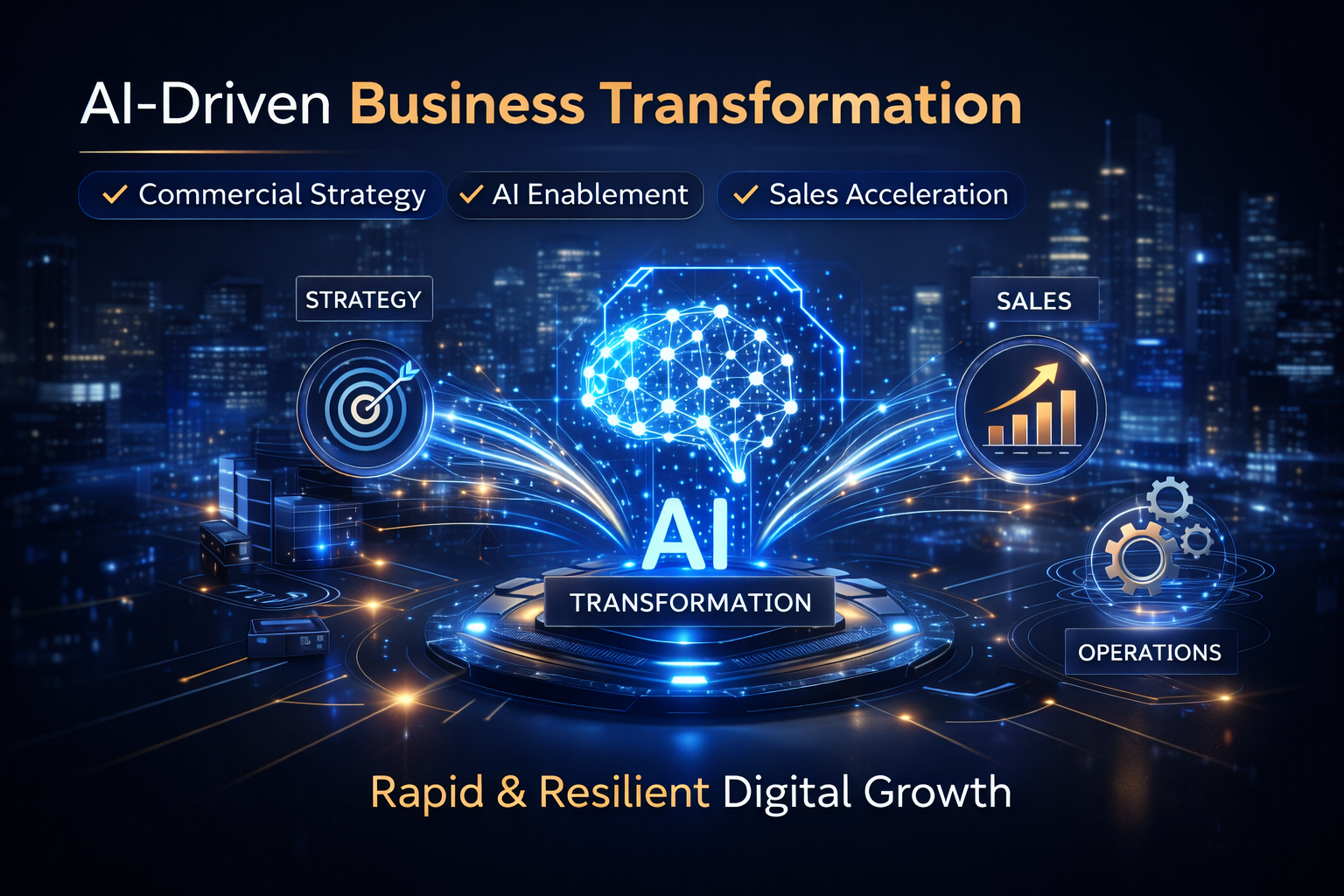

AI-driven business transformation is not about adding more tools to your organization. Most companies already rely on CRM systems, dashboards, automation, reports, and consultants, yet decision-making remains slow and fragmented. Context is scattered across tools and people, leadership carries too much implicit knowledge, and execution depends on a small number of key individuals. This service embeds AI into how the organization thinks, decides, and operates, so intelligence creates leverage instead of additional complexity.
Why AI adoption fails in most organizations
Most AI initiatives start bottom-up, driven by isolated experiments with sales tools, chatbots, internal automations, or prompt libraries. While this looks progressive, it rarely scales and usually introduces fragmentation instead of clarity.
Typical failure patterns include:
- unclear ownership of AI systems
- inconsistent usage across teams
- outputs that cannot be trusted in decision-making
- additional noise rather than reduced complexity
Over time, leadership disengages and AI is perceived as unreliable instead of strategic.
Our approach to AI-driven business transformation
AI only works when it reflects how leadership already thinks and makes decisions. We start by extracting the logic that currently lives inside the organization and already drives outcomes.
This includes:
- how strategic and operational decisions are made today
- which trade-offs matter and which do not
- what context leaders implicitly use under pressure
- which signals actually trigger action
That logic becomes the foundation of the system. From there, AI supports decision-making without removing accountability, replacing friction rather than people.
What AI-driven business transformation looks like in practice
This is not a feature rollout or a collection of tools. It is a system-level change in how the organization operates day to day.
In practice, this means:
- decisions are supported before meetings take place
- context travels with every question instead of being re-explained
- teams act without waiting for constant approval
- leadership scales without manually duplicating itself
AI becomes an operational layer the organization relies on, not something people occasionally consult.
What we build inside your organization
Leadership AI copilots
We design AI copilots trained on your strategy, commercial logic, constraints, and decision patterns. They support leadership in areas where cognitive load is highest. These copilots are used for:
- prioritization and focus
- scenario analysis
- trade-off decisions
- maintaining strategic consistency
The result is fewer repetitive questions and protected leadership attention.
Decision support across departments
Sales, operations, finance, and delivery are connected through shared context rather than isolated dashboards. AI links data and intent so teams understand what matters and why.
This typically supports decisions such as:
- which deals deserve attention today
- where execution risk is building before KPIs drop
- which actions matter now rather than what simply looks busy
Teams stop guessing and start acting with context.
AI-driven forecasting and early signals
Traditional forecasts explain what already happened. We implement forward-looking signal systems that surface risk and opportunity early.
These signals commonly include:
- early pipeline degradation
- decision bottlenecks
- workload imbalance
- execution drift
Problems become visible before results suffer, which changes leadership behavior early rather than reactively.
Structured AI governance
AI without structure creates risk and resistance. We define clear boundaries so AI is trusted and adopted across the organization.
Governance covers:
- what AI can decide
- what AI can recommend
- what always remains a human decision
- how outputs are validated and monitored
This removes black boxes and prevents uncontrolled usage.
Speed and implementation timeline
This is not a twelve-month transformation. In many cases, core systems are live within days, leadership copilots are usable immediately, and decision support starts reducing load in the first week.
Speed is possible because we:
- build on what already works
- integrate with existing systems
- focus on leverage instead of completeness
Impact is felt early without destabilizing the organization.
Typical profiles include enterprise organizations, multi-department companies, technology-driven or knowledge-heavy businesses, and leadership teams under sustained decision overload.
Outcomes you should expect
Clients typically experience:
- fewer meetings
- faster decisions
- clearer priorities
- reduced dependency on key individuals
- stronger alignment across teams
AI stops being a topic of discussion and becomes infrastructure.
This service is a fit if:
.svg)
And not if:

*Other services may still apply, contact us for more info.

How the engagement starts
We start with clarity. The engagement begins with a strategic intake where we map decision flows, identify leverage points, define what AI should replace, support, or ignore, and assess readiness and constraints. From there, we design a transformation path tailored to the organization, without generic roadmaps.

%202.avif)

How working with us looks like
We start by meeting with you to understand your needs, goals, and expectations.
1
Initial consultation
Meet with our team to discuss your needs and objectives.
2
Strategic planning
Develop a tailored plan with actionable steps for your goals.
3
Implementation
Execute the plan, providing support and guidance process.

See if this model fits your organization, request a no-obligation intake
